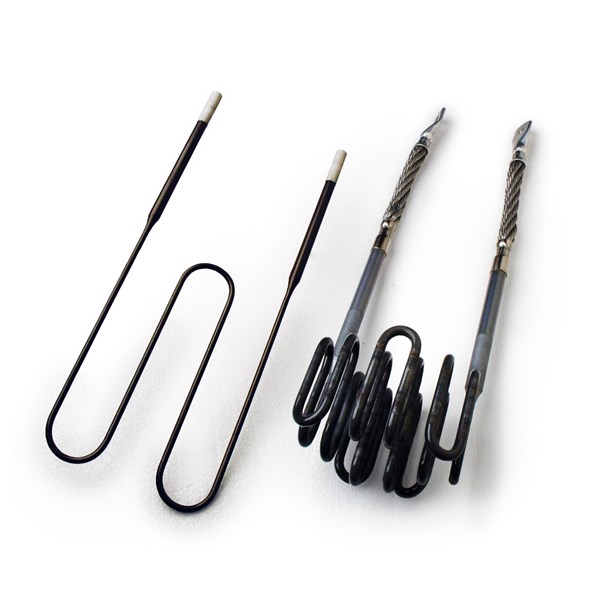
Kanthal Super® Heating Elements
Ultra High-Temperature Heating Solutions up to 1800°C
Asanjo Heating Systems supplies Kanthal Super (Molybdenum Disilicide – MoSi₂) heating elements for ultra high-temperature furnace applications where conventional FeCrAl or NiCr elements are not suitable.
Kanthal Super elements are engineered to deliver exceptional temperature capability, oxidation resistance, and long-term stability, making them the preferred choice for advanced ceramics, powder metallurgy, sintering, and laboratory furnaces.
Temperature Range & Grades
Kanthal Super elements are available in different grades, selected based on maximum operating temperature and furnace atmosphere.
Kanthal Super 1700
-
Maximum Element Temperature: 1700°C
-
Recommended Furnace Temp: up to 1650°C
-
Atmosphere: Air, oxidizing, inert
-
Typical Use: High-temperature ceramic and lab furnaces
Kanthal Super 1800
-
Maximum Element Temperature: 1800°C
-
Recommended Furnace Temp: up to 1750°C
-
Atmosphere: Air, oxidizing, inert
-
Typical Use: Advanced ceramics, R&D, specialty sintering
Atmosphere Compatibility
Kanthal Super elements perform best in:
-
Oxidizing atmospheres (Air)
-
Inert atmospheres (Argon, Nitrogen – with precautions)
-
Limited reducing atmospheres (requires controlled operation)
The protective SiO₂ (silicon dioxide) layer formed on Kanthal Super elements ensures excellent oxidation resistance and long service life.
Key Advantages of Kanthal Super Elements
-
Ultra High Operating Temperature (up to 1800°C)
-
Excellent Temperature Stability
-
Self-forming Protective Oxide Layer
-
Long Service Life in Continuous Operation
-
High Power Density & Compact Furnace Design
-
Available in U-Type, W-Type & Custom Shapes
| Parameter |
Kanthal Super (Original) |
China-Made MoSi₂ Elements |
| Raw Material Purity |
Very high, tightly controlled |
Often inconsistent |
| Maximum Temperature |
1700°C / 1800°C (true rated) |
Claimed high, often derated in practice |
| Oxide Layer Stability |
Uniform and stable SiO₂ protective layer |
Uneven oxide formation |
| Resistance Stability |
Excellent over long-term use |
Resistance drifts after thermal cycles |
| Service Life |
Long and predictable |
Shorter and unpredictable |
| Thermal Shock Resistance |
High, reliable during rapid heating/cooling |
Lower, prone to cracking |
| Performance Consistency |
Stable batch-to-batch quality |
Quality variation common |
| Long-Term Cost |
Lower due to fewer replacements |
Higher due to frequent failures |
Key Insight:
While China-made MoSi₂ elements may appear cheaper initially, Kanthal Super elements deliver far better life, reliability, and process consistency, resulting in lower total operating cost.
Applications
Kanthal Super elements are widely used in:
-
Advanced Ceramic Firing Furnaces
-
Sintering & Debinding Furnaces
-
Powder Metallurgy Furnaces
-
Crystal Growth & Special Material Furnaces
-
Laboratory & R&D Furnaces
-
Aerospace & High-Tech Material Processing
Why Kanthal Super from Asanjo Heating Systems?
-
Reliable Supply of Genuine Kanthal Super Elements
-
Technical Guidance on Grade & Atmosphere Selection
-
Custom Designs for OEM & Furnace Builders
-
Support for Replacement of Existing MoSi₂ Elements
-
Export-Ready Quality & Packaging
At Asanjo Heating Systems, we help customers choose the right MoSi₂ solution—not just the cheapest one—so their furnaces run reliably at extreme temperatures.
1. What is the expected service life of Kanthal Super elements?
The service life of Kanthal Super elements depends on operating temperature, atmosphere, and heating cycles.
-
In oxidizing (air) atmosphere at recommended temperatures, Kanthal Super elements typically deliver several thousand operating hours
-
Proper installation and gradual heating significantly extend element life
-
Compared to low-grade MoSi₂ elements, Kanthal Super offers more predictable and consistent lifespan
Key Tip: Operating close to maximum temperature continuously reduces life—proper derating improves reliability.
2. Why do MoSi₂ elements sometimes break suddenly?
MoSi₂ elements are ceramic-based materials, so breakage is usually due to:
-
Thermal shock (rapid heating or cooling)
-
Mechanical stress during installation
-
Improper support or alignment
-
Vibration from furnace structure or fans
Kanthal Super elements have better thermal shock resistance than many China-made MoSi₂ elements due to controlled raw material purity and manufacturing process.
3. Are Kanthal Super elements fragile?
Yes, like all MoSi₂ elements, they are brittle at room temperature but become stronger at operating temperature.
4. How should Kanthal Super elements be handled?
Proper handling is critical:
-
Always handle elements with both hands
-
Do not bend or twist the cold element
-
Avoid impact with hard surfaces
-
Keep elements in original packing until installation
-
Use clean gloves to avoid contamination
Many failures attributed to “poor quality” are actually handling damage before installation.
5. What are the installation guidelines?
For reliable performance:
-
Install elements stress-free (no force fitting)
-
Ensure correct element support and spacing
-
Allow for thermal expansion
-
Use recommended ceramic support blocks
-
Ensure proper electrical connections with flexible leads
Asanjo Heating Systems provides installation guidance for first-time users.
6. Is a special heating cycle required during first use?
Yes. Initial oxidation (conditioning) is very important.
Recommended practice:
-
Heat gradually to 800–900°C
-
Hold for sufficient time to allow protective SiO₂ layer formation
-
Avoid reducing atmosphere during initial startup
This step significantly improves life and stability.
7. Can Kanthal Super elements be used in reducing atmospheres?
Kanthal Super elements are best suited for oxidizing and inert atmospheres.
In reducing atmospheres:
-
The protective oxide layer can be damaged
-
Element life may reduce significantly
-
Special operating procedures are required
Consult Asanjo before selecting MoSi₂ for reducing conditions.
8. Can Kanthal Super replace existing China-made MoSi₂ elements?
Yes, in most cases.
Benefits of replacement:
Asanjo can assist with dimension matching, power calculation, and retrofitting support.
9. What causes early failure in MoSi₂ elements?
Common reasons include:
-
Operating above rated temperature
-
Rapid on/off cycling
-
Poor electrical connections
-
Furnace atmosphere not suitable
-
Low-quality MoSi₂ material
Kanthal Super minimizes these risks through material purity and process control.
10. Is Kanthal Super more expensive than China-made MoSi₂?
Initial price may be higher, but:
-
Longer service life
-
Fewer replacements
-
Lower downtime
-
Consistent performance
Total cost of ownership is significantly lower with Kanthal Super.
Kanthal Silicon carbide elements