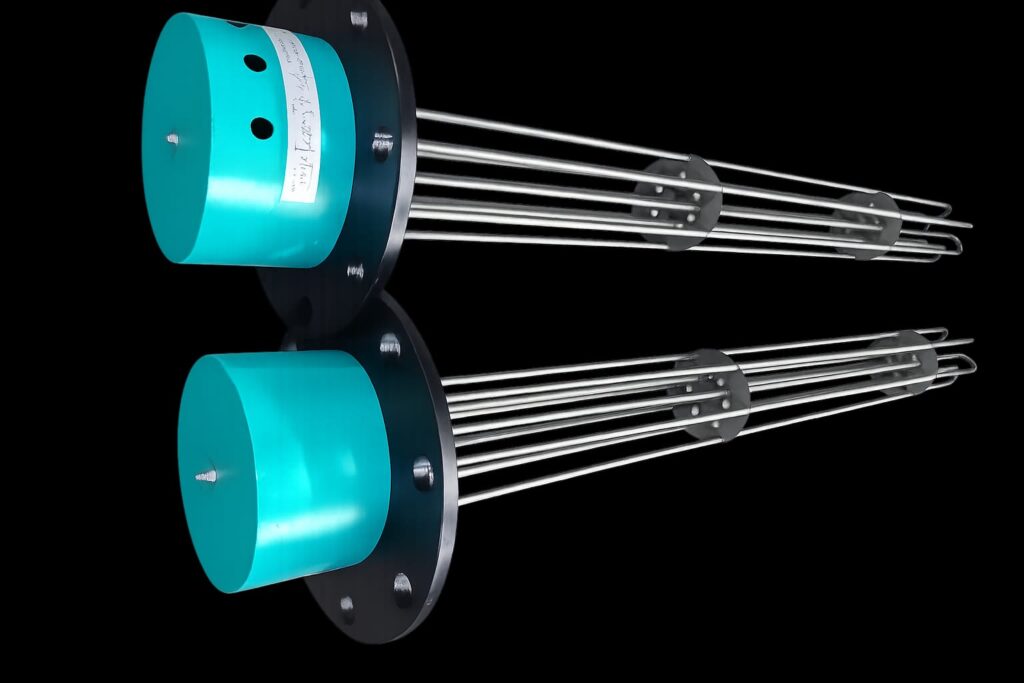
A Flange Type Immersion Heater is an electric heating assembly in which multiple tubular heating elements are brazed or welded into a flange. The flange is bolted to a tank or pressure vessel, allowing the heating elements to be immersed directly in the liquid for efficient heat transfer.
Construction
- Flange: Carbon Steel, SS304, SS316, SS316L, or other alloys
- Heating Elements: SS304, SS316, Incoloy 800/840, Titanium Grade 2, Copper, etc.
- Terminal Enclosure: IP55, IP65, IP66, or Flameproof (Ex d)
- Temperature Sensor: Thermostat, RTD (PT100), or Thermocouple
- Optional Control Panel with SCR or Thyristor power control
Working Principle
Electric current passes through the resistance wire inside each tubular element, generating heat. The heat is transferred through the sheath directly to the surrounding liquid, resulting in high thermal efficiency (typically above 95%).
Applications
- Water heating
- Demineralized water
- RO water
- Process water
- Chemical solutions
- Acids and alkalis (with suitable sheath material)
- Plating and pickling tanks
- Zinc chloride / ammonium chloride flux tanks
- Fuel oil and lubricating oil
- Thermal oil
- Boiler feed water
- Food processing liquids
Common Sheath Material Selection
| Heating Medium |
Recommended Sheath Material |
| Clean Water |
SS304 / SS316 |
| Hard Water |
Incoloy 800 |
| Demineralized Water |
Incoloy 800 |
| Sea Water |
Titanium Grade 2 |
| Acidic Solution |
Titanium / PTFE Coated / Special Alloy |
| Alkaline Solution |
SS316 / Nickel (depending on concentration) |
| Flux Solution (ZnCl₂ + NH₄Cl) |
Titanium Grade 2 (preferred) |
Advantages
- High heating efficiency
- Easy installation and replacement
- Suitable for large capacities (5 kW to over 1000 kW)
- Uniform heat distribution
- Compact design
- Can be designed for horizontal or vertical mounting
- Suitable for atmospheric and pressurized vessels
- Available with corrosion-resistant materials
Typical Design Parameters
- Power: 1 kW to 1000+ kW
- Voltage: 230 V, 415 V, 440 V, 690 V
- Frequency: 50/60 Hz
- Maximum Process Temperature: Up to 850°C (depending on sheath material)
- Pressure: Atmospheric to 40 bar or higher (custom design)
- Flange Sizes: DN50 to DN300 (2″–12″) or custom
Important Design Considerations
- Heating medium
- Operating temperature
- Tank dimensions
- Working pressure
- Heating time required
- Watt density (W/cm²)
- Sheath material compatibility
- Corrosion resistance
- Flow or stagnant condition
- Thermostat/RTD location
- Low liquid level protection
Advantages of Titanium Grade 2 over SS316 for Corrosive Liquids
| Parameter |
SS316 |
Titanium Grade 2 |
| Corrosion Resistance |
Good |
Excellent |
| Chloride Resistance |
Moderate |
Outstanding |
| Zinc Chloride Flux |
Limited life |
Excellent life |
| Service Life |
1–3 years (application dependent) |
5–10+ years (application dependent) |
| Initial Cost |
Lower |
Higher |
| Total Ownership Cost |
Higher due to replacements |
Lower due to longer service life |
For acidic zinc chloride/ammonium chloride flux tanks (pH ≈ 2, 70–80°C), Titanium Grade 2 is generally the preferred sheath material because it offers significantly better corrosion resistance and longer service life than SS316.
Information Required for Heater Selection
To design a flange immersion heater accurately, the following information is required:
- Liquid type and concentration
- Volume (L or KL)
- Initial and final temperatures
- Heating time
- Tank dimensions
- Pressure (if any)
- Supply voltage and phase
- Available flange size
- Mounting orientation (horizontal/vertical)
- Material of construction (tank)
- Continuous or batch operation
- Presence of agitation or circulation
A properly designed flange immersion heater ensures fast heating, long element life, reduced maintenance, and safe operation, particularly when the correct sheath material and watt density are selected for the process fluid.