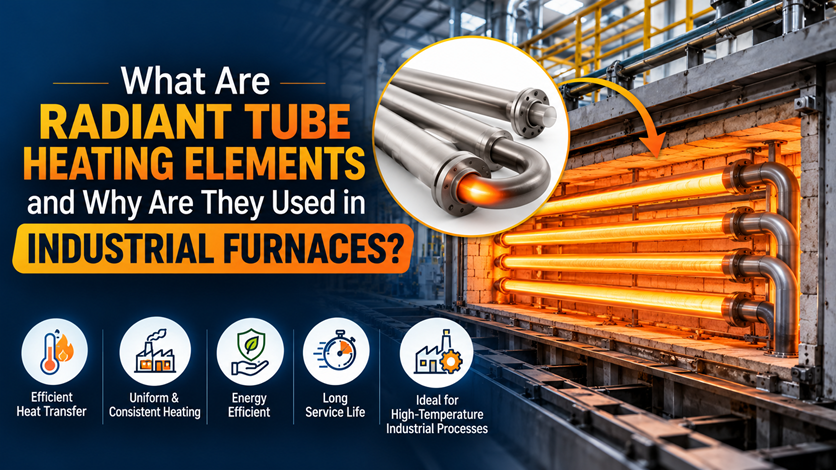
Radiant tubes are critical components in modern industrial heating systems — transferring heat precisely and efficiently without exposing the heating element to the furnace chamber atmosphere. For professionals working in metal finishing, heat treatment, or the wider furnace industry, understanding how radiant tube heating elements work is essential knowledge for optimising process outcomes, reducing downtime, and extending equipment life.
Thanks to their sophisticated construction and carefully selected materials, radiant tube heating elements improve product quality, reduce maintenance demands, and deliver reliable performance in some of the most demanding thermal processing conditions.
What Is a Radiant Tube Heating Element?
Radiant tube heating elements are enclosed tubular heating devices that transfer heat through radiation without any direct contact between the heating element and the furnace chamber atmosphere. The resistance heater sits inside a purpose-designed heat-resistant tube, which absorbs the generated heat and emits it as infrared radiation into the furnace workspace.
These elements are manufactured from heat-resistant materials selected specifically for their thermal and mechanical properties:
- Stainless steel — suitable for moderate operating temperatures
- Nickel alloys — chosen for corrosion resistance and thermal stability
- Iron-chromium-aluminium (FeCrAl) alloys — preferred for the highest operating temperatures
Standard radiant tube heating elements operate continuously at temperatures up to 1100°C. Specialist configurations using FeCrAl alloy combinations can reach operating temperatures of 1400°C — making them suitable for the most demanding high-temperature furnace applications.
How Do Radiant Tube Heating Elements Work?
Understanding the operating principle of these elements clarifies both their efficiency and their protective function within a furnace system. When electric current passes through the internal resistance heater, heat is generated according to the principle of Joule heating — and that energy is transferred in a controlled, sequential process:
- The internal resistance element generates heat through electrical resistance
- Heat transfers conductively to the surrounding radiant tube wall
- The radiant tube emits infrared radiation uniformly into the furnace chamber
- The workpiece absorbs radiant heat evenly across its surface
Because the heating element is fully enclosed within the tube, it is protected from direct exposure to the furnace atmosphere. This containment prevents oxidation or reduction of the element itself, significantly extending the operational life of the radiant tube heating element and maintaining the integrity of the process atmosphere simultaneously.
Why Industrial Furnaces Use Radiant Tube Heating Elements
Industrial furnaces operate under demanding conditions that require both temperature accuracy and long-term equipment durability. Radiant tube heating elements satisfy these requirements across several critical performance dimensions.
1. Uniform Heat Distribution Across the Furnace Chamber
One of the most significant performance advantages of radiant tube heating elements is their ability to deliver consistent, uniform heat distribution throughout the furnace workspace. Because infrared radiation reaches the workpiece evenly from all angles, temperature variation is minimised — which is particularly important in applications where consistency directly affects product quality:
- Metal heat treatment and case hardening
- Annealing and stress relief processes
- Glass manufacturing and tempering
- Ceramic kiln firing
- Controlled atmosphere food processing
Reducing temperature variation across a batch reduces the proportion of products that fail quality inspection — improving overall process yield.
2. Protection of the Furnace Process Atmosphere
Many industrial processes require a tightly controlled furnace atmosphere — either reducing, neutral, or inert — to achieve the correct metallurgical or chemical outcome. Because radiant tube heating elements isolate the heating source from the furnace chamber entirely, they allow these protective atmospheres to be maintained without contamination from the heating element itself.
This is especially important in oxidation-sensitive heat treatment processes such as bright annealing, carburising, and nitriding, where even trace atmospheric interference can compromise the quality of the treated workpiece.
3. Excellent High-Temperature Performance With FeCrAl Alloys
Continuous high-temperature operation is a fundamental requirement for most industrial furnace applications. FeCrAl radiant tube heating elements are engineered to meet this requirement — the alloy forms a dense, self-healing alumina oxide (Al₂O₃) layer on its surface during initial heating, which provides exceptional protection against further oxidation at extreme temperatures.
The performance advantages of FeCrAl alloy heating elements include:
- Superior oxidation resistance compared to conventional NiCr alloys
- Higher maximum operating temperatures — up to 1400°C in specialist configurations
- Extended service life, reducing replacement frequency and maintenance costs
- Consistent mechanical properties maintained across prolonged high-temperature cycling
- Dimensional stability that preserves element geometry under thermal stress
4. Energy-Efficient Heat Transfer
Energy efficiency is a primary operational objective for industrial manufacturers. Radiant heating delivers heat directly to the workpiece surface through infrared radiation, without the inefficiency associated with heating and recirculating large volumes of process air. This targeted heat transfer approach reduces total energy input while maintaining precise temperature control — directly lowering operating costs per production cycle.
According to the International Energy Agency, industry accounts for approximately 37% of global final energy consumption. In this context, the efficiency gains delivered by radiant tube heating elements carry both economic and environmental significance for manufacturing operations.
5. Reduced Maintenance and Extended Equipment Life
The enclosed design of radiant tube heating elements protects the resistance heating element from direct atmospheric exposure — one of the primary causes of premature failure in open-element furnace systems. This protection translates directly into:
- Lower replacement frequency and reduced spare parts cost
- Reduced unplanned downtime during production runs
- More predictable maintenance scheduling and planning
- Lower total cost of ownership over the full operational life of the furnace
Why FeCrAl Radiant Tube Heating Elements Are the Industry-Preferred Choice
As industrial processes demand ever-higher operating temperatures, material selection has become an increasingly critical factor in furnace system design. FeCrAl radiant tube heating elements have become the preferred specification across demanding furnace applications for a clear set of technical and operational reasons:
- High oxidation resistance sustained at temperatures up to and beyond 1200°C
- High dimensional stability under prolonged thermal cycling
- Strong mechanical performance retained at extreme operating temperatures
- Extended operational life compared to conventional NiCr heating materials
- Low maintenance requirements due to the protective alumina layer
- Consistent electrical and thermal performance throughout continuous operation
Where conventional heating materials begin to degrade under sustained high-temperature exposure, FeCrAl radiant tube heating elements continue to perform reliably — making them the specification of choice for furnace operators who prioritise process continuity and long-term cost efficiency.
Conclusion
Efficient and reliable furnace heating begins with selecting the correct heating technology for the application. Radiant tube heating elements deliver uniform heat distribution, complete atmospheric isolation, excellent high-temperature durability, and genuine energy efficiency — making them the benchmark choice for demanding industrial furnace applications across metal processing, heat treatment, and advanced manufacturing.
At Asanjo Heating, we supply robust, precision-engineered heating solutions — including FeCrAl radiant tube heating elements — designed to improve operational efficiency and deliver consistent thermal performance across the full range of industrial applications. Contact our team to discuss the right heating solution for your furnace system.
FREQUENTLY ASKED QUESTIONS (FAQs)
Q1. What temperature can radiant tube heating elements withstand?
Standard radiant tube heating elements are rated for continuous operation at temperatures up to 1100°C. Specialist configurations using FeCrAl alloy heating elements can operate at temperatures reaching 1400°C when combined with appropriately specified tube materials. FeCrAl alloys form a protective alumina oxide layer that provides sustained oxidation resistance at these extreme temperatures, making them the preferred material for the highest-temperature industrial furnace applications.
Q2. What is the difference between FeCrAl and NiCr heating elements in radiant tubes?
FeCrAl (iron-chromium-aluminium) and NiCr (nickel-chromium) are the two most widely used alloy types in resistance heating elements. FeCrAl alloys form a dense, self-healing alumina oxide layer during initial operation that provides superior oxidation resistance — particularly above 1100°C — and a longer operational lifespan than NiCr in high-temperature applications. NiCr alloys are better suited to lower-temperature applications and offer higher electrical resistivity at moderate temperatures. For demanding industrial furnace environments, FeCrAl radiant tube heating elements are generally the preferred specification due to their higher temperature capability and longer service life.
Q3. What industrial applications are radiant tube heating elements most suited to?
Radiant tube heating elements are widely used in any industrial process that requires precise, uniform heat distribution combined with a controlled furnace atmosphere. Key applications include metal heat treatment (annealing, hardening, tempering, carburising, and nitriding), glass manufacturing, ceramic firing, semiconductor processing, and controlled-atmosphere food processing. They are especially valuable in processes where direct contact between the heating element and the process gas would cause atmospheric contamination or product quality issues.
Q4. How long do radiant tube heating elements last in industrial furnaces?
The service life of a radiant tube heating element depends on the operating temperature, duty cycle, process atmosphere, and material specification. FeCrAl alloy elements operating within their specified temperature range typically deliver a significantly longer service life than conventional NiCr elements in equivalent conditions — owing to the protective alumina layer that limits ongoing oxidation. Correct installation, adherence to specified operating parameters, and periodic system inspections all contribute to maximising element lifespan and reducing unplanned replacement costs.