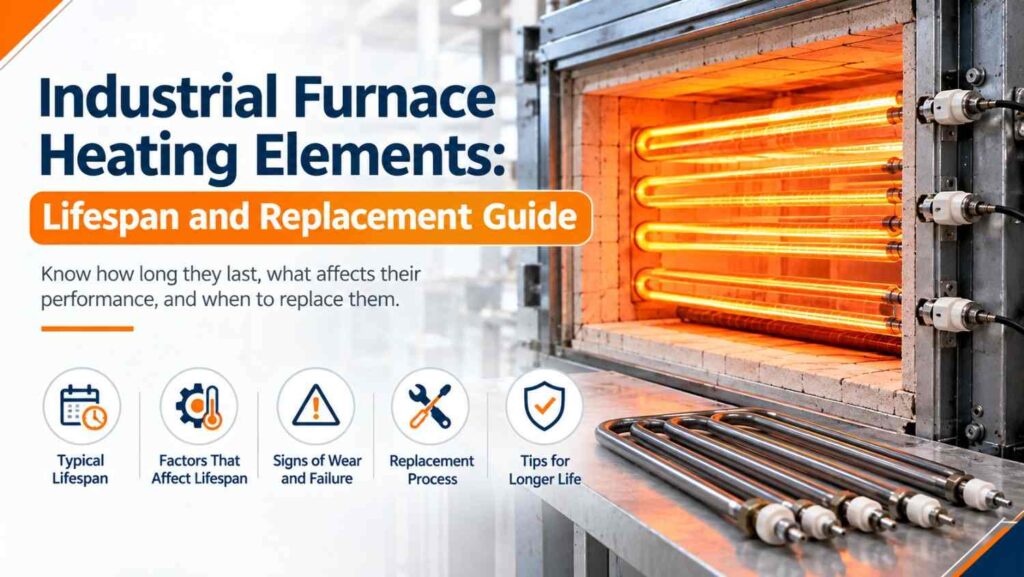
Most furnace elements last between one and five years, though the exact figure depends on material, operating temperature, and how often you cycle the furnace. If your industrial furnace heating elements are approaching that range, planning the swap costs far less than reacting to a failure mid-batch. A sudden burnout stops production, scraps product, and often damages neighbouring elements. Waiting for that moment is the costliest way to learn an element is non-functional..
This guide explains what sets element lifespan, how to catch decline early, and how to replace elements safely. Start with what decides how long yours will last.
Material Sets the Baseline Lifespan
Element material sets your starting point, because each type ages in its own way. Treat printed ranges as planning figures and confirm them against your manufacturer’s data. When you compare industrial furnace heating elements, match the material to your peak process temperature before anything else. Here is how the various types behave in service:
- Nickel-chrome wire: Rated to about 1,150°C. It is easy to swap, but it sags and oxidises over time.
- Iron-chrome-aluminium wire: Handles roughly 1,300-1,400°C. It outlasts nickel-chrome at high heat, but turns brittle once used.
- Silicon carbide: Works up to about 1,550°C. Its resistance climbs with age, so your power supply needs headroom to compensate.
- Molybdenum disilicide (MoSi2): Reaches 1,800°C and copes well with cycling. Avoid long holds between 400°C and 700°C, where low-temperature oxidation can break it down.
Duty cycle matters too. A furnace that runs one long, steady shift ages its elements differently from one that cycles every hour.
Operating Habits Cut Life Faster Than Age
Running hot, cycling hard, and letting contaminants build up shorten element life faster than calendar time does. You control most of these factors, so work through them in this order:
- Contamination: Sulfur, lead, zinc, and binder residue from parts attack element surfaces. Burn off binders with good ventilation and keep the chamber clean.
- Ramp rate: Rapid heating and cooling crack the protective oxide layer. Follow the manufacturer’s recommended ramp limits.
- Support and spacing: Sagging elements touch each other or the insulation and create hot spots.
Most early failures trace back to the first two. Both are cheap to fix.
Slower Heat-Up Is the Earliest Warning
Longer ramp times and drifting resistance readings usually appear weeks or months before an element burns out. This is where tracking pays off, because a trend across six months tells you more than a single reading. Check these points at every scheduled shutdown, and log the results for your industrial furnace heating elements:
- Longer time to reach the same setpoint
- Uneven temperatures across zones or the load
- Sagging, blistering, or bright hot spots on the element
- Resistance past the tolerance your supplier specifies
- Higher power draw for the same cycle
Replace During Planned Downtime, Not After a Failure
Replace elements at your next planned shutdown once resistance passes tolerance or failures start repeating. A forced changeout mid-run costs a batch and often takes neighbouring elements with it. Follow these steps so the job goes smoothly:
- Order ahead: when you need to buy industrial furnace heating elements, quote the furnace model, voltage, element dimensions, and atmosphere so the supplier can confirm the fit.
- Cool the furnace fully, then isolate and lock out power.
- Photograph the wiring and note each element’s position before removal.
- Inspect terminals, straps, and insulation, and repair damage first. A new element in a worn terminal fails quickly.
If the furnace is more than ten to fifteen years old and elements keep failing, check the insulation, door seals, and thermocouples too. A new set will not fix a leaking door or a drifting sensor.
Plan Your Next Changeout Before You Need It
Start with a baseline. Record the resistance of every element when the set is new, then re-measure it at each planned shutdown. That single habit tells you more about the condition of your industrial furnace heating elements than any calendar estimate.
Order spares before the first warning sign, not after, and book the change into a scheduled maintenance window. Talk to your supplier with your logged readings in hand, and you will get a useful answer.