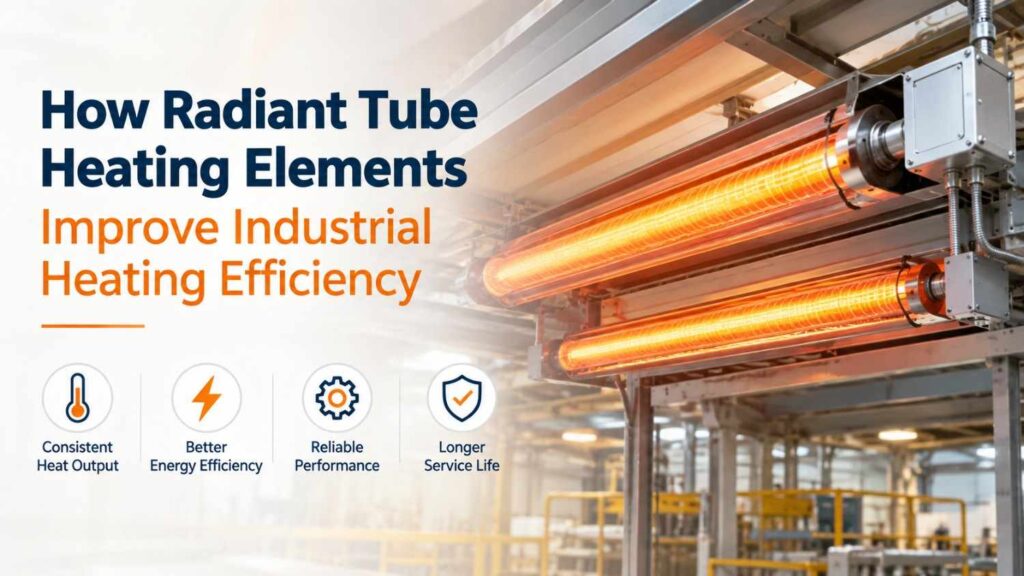
Industrial heating applications require precision, durability, and energy efficiency. This is something that conventional heating solutions struggle to deliver across the demanding operational conditions of modern manufacturing, heat treatment, and process heating environments.
The technology choices made when specifying heating equipment for these applications carry long-term consequences. This is why understanding how radiant tube heating elements achieve superior thermal efficiency compared to alternative heating approaches is important. This blog shares how these elements improve heating in industrial settings.
Understanding How Radiant Tube Heating Elements Work
They operate by containing combustion or electrical resistance heating within a ceramic or metallic tube that radiates thermal energy outward toward the target material or atmosphere without direct contact between the heat source and the process environment. Here are the core operating principles that define radiant tube heating element function-
- Heat generated within the tube radiates outward through the tube wall to the surrounding environment
- The sealed tube design prevents combustion gases or electrical components from contaminating the process
- Radiant heat transfer operates independently of convective air movement within the furnace chamber
- Uniform tube surface temperature distributes heat evenly across the target area
- Tube materials selected for specific temperature ranges and chemical exposure environments
- Electrical resistance variants offer precise control without combustion management complexity
- Ceramic and metallic alloy tube options suit different temperature and atmospheric requirements
Superior Energy Efficiency Compared to Alternative Heating Methods
The thermal efficiency advantage of radiant tube heating elements over direct-fired and open coil resistance alternatives stems from the fundamental physics of radiant heat transfer. The containment design eliminates energy losses associated with uncontrolled combustion product dispersion and inconsistent heat distribution across the process chamber. This efficiency advantage directly results in measurable reductions in energy consumption and operating costs across every hour of continuous industrial operation.
Atmosphere Control and Process Quality Benefits
The sealed containment design of radiant tube heating elements provides an atmosphere control advantage. Carburising, nitriding, bright annealing, and other controlled atmosphere processes depend entirely on maintaining precise atmospheric composition throughout the heating cycle without contamination from combustion products or heating element degradation.
Temperature Range Capability and Material Selection
The operating temperature range achievable with radiant tube heating elements depends primarily on the tube material selected for the specific application and the temperature requirements of the industrial process being served. Below are the material options and their corresponding temperature and application characteristics-
- Silicon carbide tubes offering high-temperature capability up to 1650 degrees Celsius
- Alumina ceramic tubes providing excellent chemical resistance across oxidising environments
- Metallic alloy tubes balancing thermal performance with mechanical durability requirements
- High-chromium alloys offering strong oxidation resistance at temperatures up to 1200 degrees Celsius
- Recrystallised alumina providing exceptional stability at extreme operating temperatures
- Silicon nitride bonded silicon carbide offering thermal shock resistance for cycling applications
- Composite tube designs combining inner and outer material properties for specific performance requirements
Installation and Integration Considerations
Here are the installation and integration factors that determine real-world performance outcomes-
- Tube spacing calculations ensuring uniform heat distribution across the full furnace chamber
- Mounting system design accommodating thermal expansion without mechanical stress on the tube
- Control system integration enabling precise temperature management across multiple heating zones
- Power or fuel supply sizing matching the thermal load requirements of the specific application
- Thermocouple placement providing accurate temperature feedback representative of actual process conditions
- Airflow and atmosphere circulation design working in conjunction with radiant heat distribution
- Maintenance access provision enabling tube inspection and replacement without major furnace disassembly
Maintenance Requirements and Expected Service Life
The service life of radiant tube heating elements varies significantly depending on the tube material, operating temperature, thermal cycling frequency, and the chemical aggressiveness of the furnace atmosphere in which they operate. Below are the maintenance and service life factors that industrial operators should account for in their planning-
- Visual inspection protocols for identifying surface cracking, oxidation damage, and deformation
- Electrical resistance monitoring on resistance-heated variants detecting degradation before failure
- Thermal imaging assessment identifying hot spots indicating localised element deterioration
- Atmosphere leak testing confirming tube integrity in controlled atmosphere applications
- Cleaning procedures removing process deposits that affect radiant emission characteristics
- Replacement scheduling based on operating hours, temperature cycles, and condition assessment data
- Spare tube inventory management ensuring rapid replacement capability without extended production downtime
Conclusion
The thermal efficiency, atmosphere control, and process quality offered by properly specified and correctly installed radiant tube heating elements from suppliers like Asanjo Heating make them a preferred choice for many industrial heating applications. They are particularly useful in manufacturing settings that require accuracy, uniformity, and dependable heating performance. In cases where the application requires extreme heat tolerance, chemical stability, and longevity, the selection of materials becomes crucial. There are high-performing alloy materials available, such as the FeCrAl radiant tube heating element, which have the required properties to perform under extreme conditions.